

Juice quickly—or preserve nutrients slowly? Cold press and centrifugal juicers tackle the same goal with very different approaches, and that choice shapes nutrient retention, flavor, and practicality. You’ll weigh heat, oxidation, and texture against speed, noise, and setup effort. The right pick depends on your priorities and routine, so understanding these trade-offs helps you decide what fits your kitchen best—before you commit to a direction.
Decide First: Criteria to Compare Cold Press vs Centrifugal Juicers
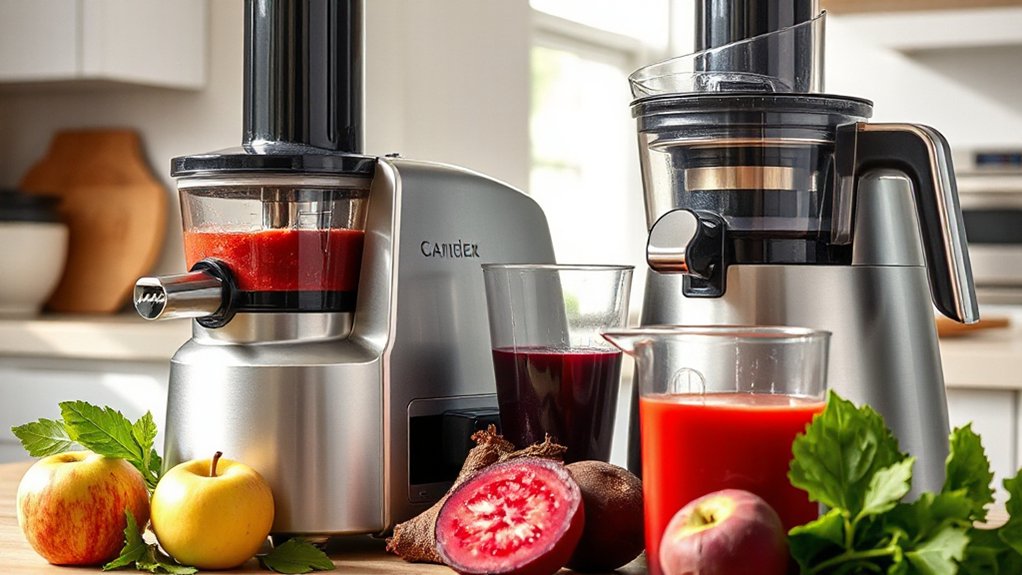
When deciding between cold press and centrifugal juicers, start by outlining the criteria that matter most to you: juice yield and quality, processing speed, nutrient retention, versatility, ease of cleaning, and price.
You’ll weigh how each factor aligns with your daily routine and goals. Juicing versatility matters for your meal planning, allowing a single machine to handle greens, citrus, and softer produce with minimal waste.
Consider machine aesthetics, because a unit that fits your kitchen and lifestyle encourages consistent use.
Expect evidence-based tradeoffs: slower extraction often boosts nutrient retention yet limits throughput; higher speed favors convenience but may compromise juice clarity.
With clear priorities, you choose a setup that feels like a natural fit, promoting long-term consistency and belonging in your healthy routine.
Cold Press vs Centrifugal Juicers: Core Design Differences
Cold press juicers use a slow auger to crush and press produce, while centrifugal models rely on a high-speed spin to extract juice. These core design choices drive differences in speed, heat generation, and efficiency.
You’ll see lower heat and better nutrient retention with cold press, but at slower throughput and higher cost. Centrifugal juicers deliver faster juice with more pulp and greater heat buildup.
This matters for juice quality factors like texture, aroma, and vitamin stability, so you can weigh the trade-offs against your priorities.
Cold Press Mechanism
Cold pressing relies on slow, screw-driven rollers to crush and squeeze juice from produce, rather than spinning blades that generate heat. You experience consistent extraction with limited friction, preserving enzymes and nutrients.
The mechanism delivers a stable, low-velocity output, minimizing oxidation and foam, which supports longer shelf life. You’ll notice a quieter operation and a cleaner extraction process than high-speed alternatives.
Juicing myths about inferior yield are debunked by data showing high efficiency with leafy greens and soft fruits when properly fed.
The historical evolution of cold press systems reveals progressively refined augers and tightly toleranced chambers, designed for reproducible results.
You gain reliability, a smoother texture, and clearer juice, aligning with a community that values longevity, quality, and informed choices in everyday health routines.
Speed and Heat Impact
Do speed and heat shape juice quality differently in cold press versus centrifugal designs, and why does that matter for nutrients and taste?
In cold press machines, slow grinding and low heat preserve heat-sensitive nutrients and enzymes, supporting steadier flavor over time.
Centrifugal juicers, by contrast, generate more friction and higher speeds, which can slightly degrade certain nutrients and introduce warmer temps during processing.
This kinetic difference affects juicing versatility for mixed produce and greens, since gentler extraction minimizes oxidation while rapid spinning favors high yield for tough produce.
Maintenance ease matters here: slower, closed systems reduce splash and heat buildup, simplifying cleanup.
Choose based on your routine; your sense of belonging grows from consistent results, fewer pauses, and reliable performance.
Juice Quality Factors
Which core design differences most shape juice quality between cold press and centrifugal juicers, and why does that matter for flavor and nutrient retention?
You’ll notice that cold-press extraction preserves delicate compounds by slower processing and minimal heat, yielding richer flavor and steadier nutrient profiles.
Centrifugal juicers deliver rapid, high-speed extraction, creating more friction heat and oxidation, which can blunt nuance and shorten shelf life.
In terms of juice shelf life, cold-pressed juice typically stays fresher longer when refrigerated, thanks to reduced enzymatic activity and gentler handling.
Pulp texture also matters: cold-press produces smoother, more uniform juice with finer pulp, while centrifugal often leaves variable pulp and foam.
Your choice signals belonging to a platform that prioritizes precision, evidence, and practical, shareable results.
How Extraction Methods Affect Yield and Foam
Extraction methods directly influence yield by how efficiently each system extracts juice. Cold-press tends to preserve more liquid with less waste, while centrifugal juicers may spit out more foam and create a quicker drop in volume.
Foam formation and texture reflect processing shear and centrifugal force, with higher speeds generating more emulsified bubbles and a lighter, frothier top.
You’ll see these differences shift depending on produce type and prep, so matching method to expected yield and foam profile matters for consistency.
Extraction Impact On Yield
When you choose between cold press and centrifugal juicers, extraction methods directly shape yield and foam. You’ll notice higher juice yield from cold press approaches due to slower, crushing mechanics that minimize nutrient loss and reduce air incorporation.
Centrifugal systems extract quickly but often push more pulp into the juice, lowering apparent yield and increasing foam with certain produce. Your choice also affects consistency: cold press tends toward thicker, richer juice, while centrifugal yields lighter, more aerated liquid.
Consider juicing accessories that optimize extraction, like tamper tools and pulp screens, to maximize usable juice. Read customer reviews to gauge real-world yields for your typical produce mix.
Balanced expectations save time and support reliable results you can share with fellow enthusiasts.
Foam Formation And Texture
Your goal is juice clarity, not just volume, so observe how quickly foam dissipates after pouring and whether bubbles cling to the sides. Pulp consistency also signals method effects: a finer, uniform pulp usually accompanies colder, slower extraction, while coarser pulp is common with high-speed systems.
For recommended taste and mixing, allow a brief settling period and stir gently. These cues help you choose equipment that aligns with your texture preferences while preserving nutritional value.
Nutrient Retention in Cold Press vs Centrifugal Juicing
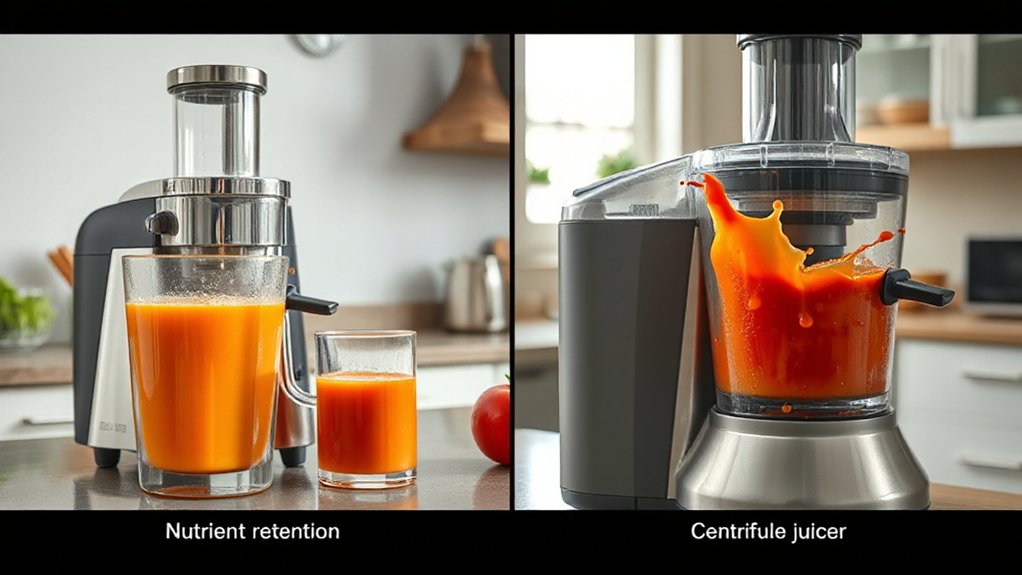
Cold-press juicers generally retain more nutrients than centrifugal models because the slower pressing action minimizes heat, oxidation, and nutrient degradation.
In practice, you’ll observe higher levels of vitamin C, polyphenols, and enzymes preserved in cold-press juice, especially for leafy greens and colorful berries. The gentler extraction reduces the shock of rapid shear, helping antioxidants stay intact through processing.
You’ll also benefit from more stable micronutrients during light, short-term storage, given lower heat exposure. Juicing efficiency matters here because consistent press force and slow torque reduce nutrient loss per unit of juice.
Pulp separation is typically more thorough, indicating efficient extraction of juice while leaving behind fewer nutrient-rich fibers.
Flavor and Texture: Brightness, Browning, and Pulp
Brightness, browning, and pulp are practical indicators of flavor and texture that matter in cold-press and centrifugal juicers. You’ll notice brightness hints at fresh, vibrant notes, while browning signals oxidation risks and shorter shelf life.
Texture reveals how you perceive juice integrity: smoother from careful pressing, rougher if pulp remains. Centrifugal machines often yield brighter juice with lighter mouthfeel but can introduce faster browning due to exposure to air.
Cold-press devices tend to preserve deeper color and more uniform pulp, contributing to a perceived richness. To optimize outcomes, choose appropriate juicing accessories, like fine-mesh strainers or additional jigs, and plan juice storage in opaque, airtight containers.
Your choices influence both flavor fidelity and longevity, shaping a confident, belonging-based juicing routine.
Daily Use Realities: Speed, Noise, Setup, and Cleanup
Daily use realities hinge on practicalities: speed, noise, setup, and cleanup can determine whether juicing fits into your routine. You’ll notice centrifugal units often deliver quick yields, yet may require longer cleanup due to grated pulp and filter screens.
Cold press models tend to run slower but produce steadier output. In busy mornings, speed matters, but consistency matters more for juice preservation over the day.
Noise levels influence whether you juice early, late, or nearby others, guiding your choice of location. Setup should be straightforward, with minimal disassembly for daily use.
Cleanup must be efficient to keep you returning; look for accessible parts and dishwasher compatibility. Consider pulp dryness post-press, and plan routine accordingly to sustain habitual, high-quality juice without frustration.
Price, Durability, and Total Cost of Ownership
When weighing price, durability, and total cost of ownership, you should look beyond upfront price to long-term value and reliability. Over time, a higher-quality juicer often saves money through fewer replacements and better performance, whether you choose cold press or centrifugal.
Durability matters because components like seals, augers, and cutting screens wear at different rates, affecting maintenance needs and resale value.
Total cost of ownership includes energy use, parts availability, and ease of servicing, which influence how often you’ll replace gear or pay for repairs.
Consider juice shelf life under use scenarios and how that impacts waste.
Also, evaluate ease of cleaning, since simpler, quicker cleanup protects your investment and encourages consistent, enjoyable juicing.
Use-Case Scenarios: Which Juicer Fits Your Routine
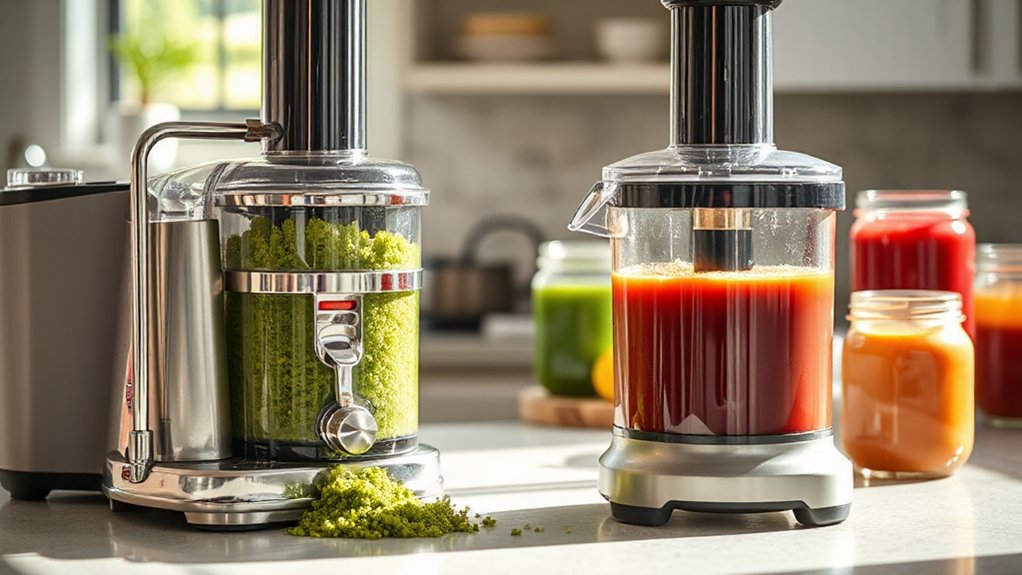
Consider how you plan to juice most often, then map that to a juicer type: if you crave quick, high-volume results for busy mornings, a centrifugal model shines.
If you value nutrient preservation and consistent single-serve portions, a cold-press (masticating) device fits better. Use-case awareness helps you choose without overthinking.
For daily routines, a centrifugal juicer speeds up breakfast jams and reduces prep friction, while a cold-press model suits weekend blends and stored juice for later.
Practical tips: plan batches, optimize cleanup windows, and align juicer storage with your counter space to maintain consistency.
Cleaning techniques matter; rinse immediately after use, disassemble per manual, and air-dry parts.
Your routine benefits from clear organization and reliable, long-term performance.
Juicer storage becomes a quiet, accessible habit.
Quick Decision Framework: Pick Cold Press or Centrifugal With Confidence
To decide between cold press and centrifugal juicers with confidence, start with your priorities: nutrients and single-serving portions favor cold press, while speed and high daily output favor centrifugal.
In practical terms, you assess Juicing versatility: will you mix greens, citrus, and supplements, or mostly produce quick, large batches?
Cold press preserves nutrients longer and yields richer colors, but you trade speed for gentler extraction.
Centrifugal delivers rapid results, ideal for busy mornings and family routines, though nutrient degradation can occur with time and heat.
Align your choice with Appliance aesthetics: a compact unit blends with minimalism, while a stylish, high-capacity model signals purposeful design.
Use this framework to lock in the option that supports belonging to your kitchen community and daily rituals.
Frequently Asked Questions
How Do Noise Levels Compare in Real-World Use?
In real-world use, centrifugal juicers generate louder motor noise, impacting user comfort more than cold press models. You’ll notice steadier, quieter operation with cold press designs, which enhances focus, balance, and overall enjoyment during juicing.
Which Juice Types Maximize Cold Press Benefits?
You maximize cold press benefits with juices from fruit varieties high in fiber and pulp, such as apples and berries, preserving Nutrient retention. You’ll notice richer flavors, sharper color, and evidence suggesting steadier micronutrient delivery for your routine.
Are Cleaning Times Significantly Different Between Models?
Cleaning efficiency varies by model, but you’ll notice centrifugal units often clean quicker; cold pressers, while slower, reduce buildup. Maintenance requirements are modest across the board, though higher-end options offer easier cleaning and better long-term reliability.
Do Warranties Cover Motor Burnouts or Blade Wear?
Like a trained chef, you’ll want certainty. Warranties typically exclude motor burnouts and blade wear unless defects appear from manufacturing. Check warranty exclusions; motor reliability varies by brand, model, and maintenance. You belong with clarified, evidence-based protection.
Which Juicer Preserves Enzymes Best in Practice?
You’ll preserve enzymes best with a cold-press juicer, which enhances nutrient retention and maintains minimal heat. You’ll notice higher extraction efficiency, fewer oxidized bits, and a cleaner, more cohesive juice profile that supports ongoing adherence to healthy routines.
Conclusion
When speed and convenience push you toward a centrifugal model, you gain quick juice and a clean counter, yet you trade some nutrients and gentler flavor for heat and oxidation. If you prioritize nutrient retention and richer flavor, a cold press delivers—even if it takes longer and costs more. Juicer choices mirror life: instant results versus lasting quality. Play to your routine, appetite for variation, and willingness to wait, and you’ll pick the right tool for daily importance.